
Honolulu County Court Records After Arrest
The arrest-to-court path in Honolulu County starts with HPD arrest reporting, then moves through release, court transport, OCCC intake, prosecutor review, and Hawaii Judiciary case records. HPD release codes make the path clearer than in many counties. DCT means taken to District Court for arraignment. CCT means taken to Circuit Court. FCT means Family Court. PVC means prosecution via complaint. RPC and RNC warn that a court case may not exist because prosecution was declined or no formal charge was filed.
Those police entries are different from the court record itself. HPD arrest logs document the arrest event. Honolulu County jail inmate records deal with custody and DCR confirmation. Honolulu County jail mugshots are handled through HPD Records requests, not the court portal. Court records after a jail arrest show the filed case, charge list, bail or bond information, docket activity, hearings, and disposition.
Find Court Records After a Honolulu Arrest
The official public case-search system is eCourt Kokua. The Judiciary manual says users can search by party, case, vehicle, upcoming court hearings, and documents. A search may require accepting a disclaimer or completing reCAPTCHA. Public case information can be searched without buying documents, but public PDF copies may require payment.
- Read the HPD release code to decide whether the arrest likely moved to District, Circuit, Family Court, OCCC intake, or release.
- Open eCourt Kokua and use Party Search when the person's first and last name are known.
- Use Case Search when a Case ID, Application Number, Arrest Number, OTN, SID, or filing-date clue is available.
- Open the case Summary, then check Events, Dockets, Offenses, and Bail/Bond Information.
- Use the upcoming-hearing search if the immediate need is the next court date.
The Hawaii Judiciary eCourt Kokua help page explains case availability and document access.
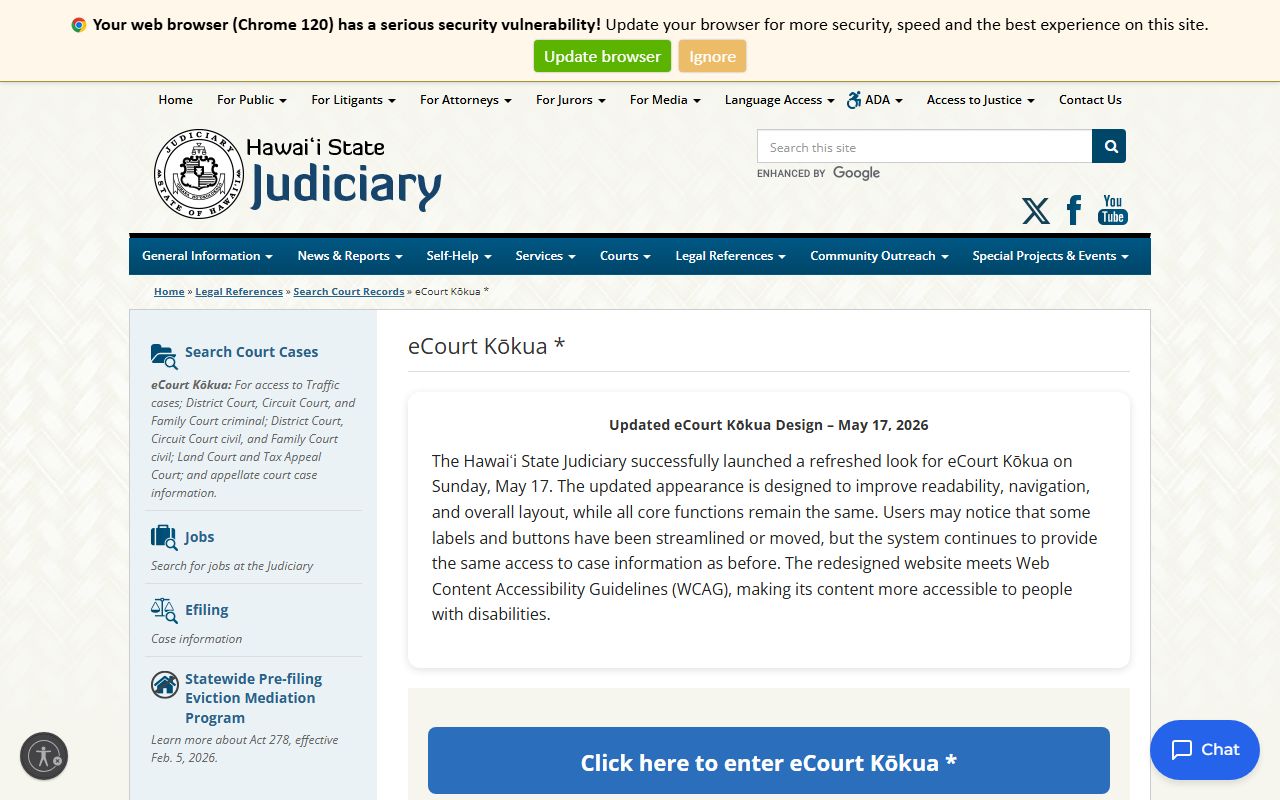
The help page belongs with the court-record search because it explains what the public case system can and cannot show.
Honolulu Court Record Search Fields
eCourt Kokua has two useful criminal-case search routes after a jail arrest. Party Search is best when the name is known. Case Search is better when an arrest number, OTN, SID, case ID, or filing-date information came from a police report, attorney, court notice, or custody record.
| Field label | Type | Required | Notes |
|---|---|---|---|
| Last Name | Text | Yes for person search | Used with first name in Party Search. |
| First Name | Text | Yes for person search | Middle name is optional for precision. |
| Phonetic / Partial Search | Checkbox | No | Useful when spelling is uncertain. |
| Case ID | Text | Minimum for Case Search | Direct route when the case number is known. |
| Arrest Number, OTN, SID | Text | Optional | Useful after arrest when these identifiers are available. |
| Filing date range | Date range | Required for filing-date search | Manual notes that ranges over 60 days return an error. |
Charges Filed After Arrest
After a Honolulu County arrest, the prosecutor decides what charge record, if any, moves forward. The Department of the Prosecuting Attorney, City and County of Honolulu, is the local prosecuting office. Its public site identifies Steven S. Alm as Prosecuting Attorney. The filed charge may not match the HPD arrest-offense label because police arrest information and prosecutor-filed charges serve different roles.
| Document | Who files it | How it is used |
|---|---|---|
| Complaint | Prosecutor | Often starts prosecution by setting out the charge after police review. |
| Information | Prosecutor | Formal charging document used in some felony contexts after required procedure. |
| Indictment | Grand jury | Grand-jury charging document, usually tied to more serious felony matters. |
Honolulu Charge Status Terms
Charge status can change after the first filing. A charge may be pending, amended, reduced, dismissed, disposed by plea, or resolved after trial. eCourt Kokua's Offenses, Events, and Dockets tabs should be read together because one tab may show the charge while another shows minutes, hearing outcomes, or documents.
| Status | What it means |
|---|---|
| Pending | The charge remains active and the case has not reached final disposition. |
| Amended or reduced | The charge changed from the first filed version, often by court order or prosecutor action. |
| Dismissed | The charge was dropped by the court or prosecution and is not a conviction. |
| Acquitted | The person was found not guilty of that charge. |
| Convicted | The charge was resolved by guilty plea, no-contest plea where applicable, or verdict. |
Bond After a Honolulu Arrest
Hawaii bail law is found in HRS chapter 804. HRS section 804-3 says a person charged with a criminal offense is generally bailable by sufficient sureties, but bail can be denied for serious crimes when risks such as flight, obstruction, witness intimidation, or danger are present. HPD release codes also show release outcomes, including RBL for bail or bond posted and ROR for release on own recognizance.
| Term | Honolulu use |
|---|---|
| Bail | Security or release condition set under Hawaii court authority. |
| Own recognizance / ROR | Release without cash bail, with a promise and conditions. |
| Serious-crime denial | Bail may be denied when statutory risk findings are present. |
| Detainer or hold | Another agency's hold may keep a person in custody even if one case has release terms. |
Warrants and Court Records After Arrest
HPD's warrant policy says warrants are legal documents issued by judicial authority for search, seizure, or arrest. It lists grand jury, parole revocation, Hope Probation, juvenile, traffic, misdemeanor, and felony warrants. Public lookup is limited. HPD policy routes public warrant-information requests to the Records and Identification Division, and HIJIS/eBench warrant access is for authorized law-enforcement users. A warrant arrest may create separate arrest reports and separate OTNs when multiple warrants or outside-assist pickups are involved.
Important: Web results may miss active warrant or hold data; verify through official HPD, court, or agency contact paths.
Charges vs Convictions
A court record after arrest can list accusations long before guilt is decided. The charge is the allegation filed in court. A conviction is the result of a guilty plea, no-contest plea where accepted, or a finding after trial. Public record users should not treat an arrest or filed charge as a conviction.
| Charge | Conviction | |
|---|---|---|
| Stage | Accusation after arrest and filing | Final or adjudicated outcome |
| Where found | Offenses, complaint, information, indictment, dockets | Disposition, judgment, docket entries, criminal-history result |
| Meaning | Not proof of guilt | Court-resolved guilt finding or plea result |
Sealed and Expunged Arrest Records
HRS section 831-3.2 allows qualifying people arrested for or charged with, but not convicted of, a crime to apply for an expungement order. The statute defines arrest record to include photographic and fingerprint cards connected to the arrest. Effective July 1, 2025 language also requires court sealing or removal from public electronic databases when an expungement order listing the court case number has been entered and transmitted.
| Sealed | Expunged | |
|---|---|---|
| Public view | Hidden or masked from public access, such as sealed or in-camera dockets. | Qualifying arrest record is annulled, canceled, or rescinded by order. |
| Photos and fingerprints | May still exist under restricted access. | Applicant may request return of arrest fingerprints or photographs. |
| Online court data | Sealed files are not sold through eCourt Kokua. | Qualifying court files can be sealed or removed from public electronic databases. |
Document Copies and Fees
eCourt Kokua searches are separate from document purchases. The Judiciary manual says public documents may be regular file-stamped copies or electronically certified copies. A standard file-stamped copy costs $3.00 per document or 10 cents per page, whichever is greater. A certified copy adds $2.00 per document. Sealed and in-camera documents cannot be purchased online, and some documents that are not available online may still be available over the counter.